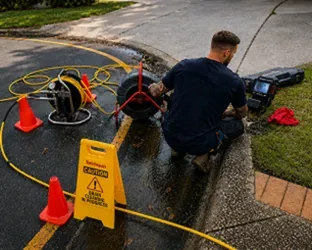
Cleared the same day where we can, with a camera down the line when it keeps coming back. On a floodplain the first job is working out whether it is your drain or the street's, and that conversation happens before anyone is dispatched.
Online Now!·--:--
There are three separate things people call a blocked drain out here, and they have different causes, different costs, and in one case no cost at all.
The first is a genuine one-off: something went down that should not have. Wipes sold as flushable, cooking fat that set as it cooled, a toy posted down by someone small. Those clear properly and stay cleared.
The second is a drain that backs up every few months on ordinary dry days. That is the pipe telling you something. On the older blocks it is almost always roots in the earthenware sewer, and clearing it is treating the symptom.
The third is the one specific to this district. When a heavy band of rain sits over the Nepean catchment, more water enters the sewer system than the main can carry, and the street's line surcharges. Your yard gully overflows because it is designed to. Nothing on your property is blocked, and no amount of jetting will change it. Knowing which of the three you have is most of the diagnosis, and it is free to work out on the phone.


Tell us which fixtures are affected and whether it only happens in heavy rain. Those two answers usually decide the job before we arrive.
The post-war streets were built with earthenware sewer, laid in short lengths with mortared joints, on blocks of 600 square metres and up. Every one of those joints is a seam, and the trees planted when the house went up are now mature.
Clay soil here shrinks back through a dry spell and swells again when it rains. That seasonal movement works on the joints until one opens by a millimetre or two, which is all a root needs. Once roots are inside they regrow after every clear, which is why the same drain blocks at roughly the same interval year after year.
Sewer and stormwater are separate systems. In sustained heavy rain, groundwater and run-off find their way into the sewer through cracked pipes, loose gully surrounds and illegal downpipe connections across the whole street, not just yours. The main fills, and the system relieves at the lowest opening it can find.
The tell is timing. Surcharge tracks the rain and clears not long after it stops. A blockage does not care what the weather is doing. If your line only misbehaves during a downpour and is faultless the rest of the time, the honest answer is that there is nothing on your property to fix, and we would rather tell you that than sell you a clear.
Is it one fixture or several? A single slow basin is usually local to that fixture. Several at once, or a toilet and a shower together, means the problem is further down the line and shared.
Is the yard gully overflowing? That is the relief point, and if it is running while fixtures inside are backing up, the blockage is downstream of the house.
Is it raining, or has it been raining hard for hours? Say so when you call. It changes our advice completely and it may save you a call-out.
Clearing a root-invaded line buys you months, not years. A camera down the same line tells you where the intrusion is, how far along, whether the pipe has deformed or cracked, and whether the fault sits on your side of the boundary at all.
You watch the footage while we are there, and you keep a copy. That matters if the answer turns out to be relining, because the same footage is what a strata committee, an insurer or a buyer's conveyancer will ask to see.
Out through Jordan Springs, Caddens and Claremont Meadows the line is modern PVC in continuous runs. Roots have far less to exploit, so a repeat blockage there points at something else: a section laid without enough fall, damage from later landscaping or a pool install, or a construction defect still inside its warranty period.
We check the warranty question before quoting. If the builder should be fixing it, you should not be paying us to.
Every job is quoted at a fixed price before it starts. These are indicative 2026 ranges for this area, not quotes, and if the problem turns out to be street-side surcharge you are not charged to confirm it.
Hand tools or an electric eel through an existing access point. Most jobs land here.
High-pressure water where an eel will not do it, or where grease has lined the pipe.
Down the line with the footage handed over. The right call on a second blockage.
Mechanical cutting back to clean pipe, then a camera pass to show what is left.
Issued with the footage, so you have it for an insurer, a strata or a sale.

Which fixtures, how long, and whether it tracks the rain. If it reads as street-side surcharge we say so before dispatching anyone.

We work from the nearest existing access point so the job stays contained and nothing backs up through the house while we are clearing.

A first blockage gets cleared. A repeat gets the camera, because the interval is the pipe telling you something and guessing is expensive.

You watch the footage on the screen, we explain what is on it in plain terms, and the report goes to you with the invoice.
Stop using every fixture on that line, including the washing machine, and call. If it is raining hard, say so, it changes what we tell you to do next.
Call 1300 381 569
Often it is not, and this is the single most useful thing to know out here. Sewer and stormwater are separate systems. When a downpour puts more water into the sewer than the main can carry, the whole street's system surcharges and the lowest relief point on your property, usually the yard gully, overflows. Nothing on your property is blocked. If it clears within an hour of the rain stopping and behaves perfectly the rest of the time, that is surcharge. If it is slow on a dry Tuesday, that is a blockage, and it is worth paying to fix. We will tell you which on the phone rather than sending a jetter to rain.
The gully is doing its job. It is deliberately the lowest opening on the property so that when the line surcharges it relieves outside rather than through a shower or toilet inside. The thing to check is that nothing has raised the ground around it or buried it under mulch or a garden bed, because a gully sitting below the surrounding soil cannot relieve, and the next lowest opening is usually the shower floor. Keeping the grate clear and the surround above ground level costs nothing and prevents the expensive version.
Roots, most of the time. The post-war streets through Cambridge Park, Kingswood, Werrington and South Penrith run earthenware sewer laid in short lengths with mortared joints, on blocks big enough to have grown substantial trees over the top of it in the sixty-odd years since. Clay soil that shrinks back through a dry spell opens those joints slightly, roots find the moisture, and once they are in they regrow after every clear. That is why a repeat blockage is a pipe problem, not a habits problem.
Yes, and it changes what we bring. Jordan Springs, Caddens, Claremont Meadows and the newer parts of Glenmore Park are plumbed in modern PVC in continuous runs with no mortared joints for roots to exploit. A repeat blockage there is far more likely to be a fall problem, a construction defect, or something physically lodged in the line than roots. On a house still inside its builder's warranty period that distinction is worth money, so we check it before quoting you for anything.
On a soft soap or grease build-up in a basin, sometimes. On the things that actually block a sewer here, roots, wipes, a collapsed section, no. They generate heat, they sit against the blockage rather than passing through it, and on old earthenware or a PVC trap that heat does real damage. They also make our job harder and less safe, because the water we then have to work in is caustic. If you have already poured one in, say so when you call.
Most straightforward clears through an existing access point land between $150 and $400. A stubborn line that needs the jetter is $400 to $700. A camera inspection is $250 to $450 and comes with the footage. You get a fixed figure before anything starts, and if we get there and find it is street-side surcharge rather than your blockage, we tell you that and you are not paying us to fix something that is not broken.
No, and they are the most common avoidable cause of a blocked sewer we attend. They clear the S-bend, which is all the label really promises, then they fail to break down the way paper does. They catch on anything rough in the line, and on a jointed earthenware sewer with roots already in it there is plenty to catch on. Once a few collect, everything else builds behind them. Same for paper towel, cotton buds and cat litter sold as flushable.
Tell us which fixtures are affected, whether it has happened before, and whether it only does it in heavy rain. Those three answers decide the job.
Fixed price agreed before we start, and you see the footage of anything we recommend.
Online Now!·--:--