Local leak guide
What actually goes wrong with pipes in Penrith
Galvanised that looks fine from the outside
Galvanised steel corrodes internally, so the outside of the pipe can look entirely sound while the bore has narrowed to a fraction of what it was.
That produces falling pressure across the whole house, developing over years, which people attribute to the water supply rather than to their own pipework.
It is a slow and unusually honest signal, and it gives time to plan a replacement rather than react to a failure.
Heat cycling, and pipework in the roof
Penrith recorded 48.9 degrees on 4 January 2020, the highest temperature ever measured in an Australian metropolitan area, and a roof space on a day like that is hotter again.
Pipework and fittings up there expand and contract through a far wider range than anything closer to the coast, and repeated cycling works on joints over years.
So a roof space is worth including in any inspection here, and it is the part of a house nobody ever looks at.
The wet patch that is not rain
An underground leak on a pressurised line runs continuously, so the ground above it stays damp through dry weather when everything around it has dried out.
On reactive clay that is also ground that is being made to swell in one place, which over time affects whatever is above it.
A patch that stays green or soft through a dry spell is worth investigating rather than watering less.
The meter is the honest test
Shut every tap and appliance and watch the meter for a quarter of an hour. Movement with nothing running means water is genuinely leaving on your side.
Turn any irrigation off entirely rather than to a rest day, or it will run during the measurement and confuse the result.
In this climate irrigation is frequently the largest single use on a property, so isolating it properly matters.
Then isolate the hot water and read it again
Close the valve on the inlet to the hot water unit and watch the meter a second time. Still moving is the cold side. Stopped is the unit or the hot line past it.
Check the relief valve outlet before assuming the worst on a hot result, because on a hot day a valve that is relieving reads exactly like a leak.
That is a more common false positive here than in cooler suburbs.
Finding it before opening anything
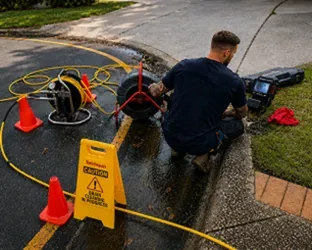
The point of leak detection is to open one spot instead of five. Acoustic listening, pressure isolation and thermal imaging narrow a whole property to a point.
On slab-on-ground housing thermal works particularly well, because concrete conducts and spreads the heat from a hot water line.
The cost of doing it properly is almost always less than the cost of guessing wrong once.
Flexi hoses in the newer estates
Jordan Springs, Caddens and Claremont Meadows are new enough that the original braided hoses are now reaching the end of their service life together.
They fail all at once, at mains pressure, in cupboards nobody opens, frequently while the house is empty.
Whole streets fitted out in the same year reach that point in the same year, which makes this worth doing before rather than after.
Most flood damage is not flood damage
This is a floodplain district and people reasonably associate water in a house with the river. The great majority of the water damage we attend has nothing to do with it.
It is a hose, a burst pipe, a failed cylinder or a slab leak, in houses nowhere near a flood level.
Worth saying, because the ordinary precautions matter here as much as anywhere and get overlooked in favour of the dramatic risk.
Where it shows is not where it left
Water follows the fall of a joist, the underside of a slab or the line of a trench and surfaces wherever it finally escapes.
So a damp patch is a starting point rather than an address, and on a large block it can be a long way from the failure.
That is the argument for locating before cutting, and it applies indoors and out.
Find your stop tap before you need it
Not in the dark, in the rain, on the night it matters. Find the meter, find its tap, and check the tap actually turns on a dry afternoon.
On older properties they seize, and a seized meter tap is its own small job on a quiet Tuesday rather than a crisis at midnight.
Learn the isolating valves indoors too, because closing one handles a specific failure without taking water off the house.
Pressure is worth measuring
The domestic ceiling is 500 kPa static at any outlet, and the valve that holds it there wears out at around eight to twelve years and fails open.
Read the symptoms together. Taps that keep dripping after repair, water hammer that was not there before, and appliance inlet valves failing early all point the same way.
It is a gauge and two minutes, and in a district with a lot of same-age housing, whole streets reach that point together.
What to keep, and why
Dates, findings, photographs and the invoice from a licensed plumber. Together those describe a concealed leak and its repair in a way anybody assessing it can follow.
Sydney Water has an allowance for exactly that situation, with conditions they set and publish.
We are not assessors and will not advise on eligibility. We will make sure the record exists and is accurate.