Local relining guide
What relining actually is, and when it suits Penrith
How it works, without the brochure language
A liner saturated in resin goes into the damaged section, gets inflated against the existing pipe wall, and cures there into a new pipe formed inside the old one.
Continuous, smooth, slightly smaller in bore and structural in its own right rather than a coating over a problem.
It goes in through existing access, so the lawn, the driveway and the garden stay where they are.
Patch, or the whole run
Where the camera shows one bad joint in an otherwise sound pipe, a patch liner over that section is the proportionate answer and it is considerably cheaper.
Where openings appear along the length, which on sixty-year-old earthenware under mature trees is common, lining the run is the honest recommendation.
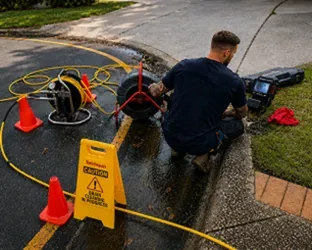
The footage decides which, and you should see it rather than be told about it.
Reactive clay is why the joints opened
The soil through much of this district shrinks when dry and swells when wet, and that seasonal movement is what has been working the joints of an old line for sixty years.
So the root problem is downstream of a ground movement problem, and neither the tree nor the roots are really the cause.
Removing every joint removes what the clay has to work on, which is why a liner lasts where a cut does not.
Junctions, and the step people forget to ask about
A liner covers the openings where branch lines join the main, so those are cut back open from inside once the resin has cured. It is routine and it gets confirmed on camera.
A missed one stops that branch draining, which is immediately obvious rather than hidden.
Ask to see the after footage. It exists either way and it is how you check the junctions are open.
When we will tell you not to reline
A collapsed pipe cannot be lined, because there is nothing left to cure against. That length has to be excavated and replaced.
A pipe that has lost its fall cannot be fixed by lining either, because the liner inherits the gradient of the host including the part that dropped.
On reactive clay both are real possibilities, and both are visible on camera in seconds.
Digging is genuinely available here
Post-war blocks in this district are large, side access is usually real, and a machine can generally reach the line without taking a fence out.
So unlike the inner suburbs, excavation is a genuine alternative rather than a theoretical one, and the comparison is a real comparison.
Where a section has to be relaid at the correct fall, it is also the better answer, and we will say so.
Buying an older place around here
If you are buying anything built before about 1980 in this district, a camera survey of the drainage is worth doing alongside the building and pest inspection.
Neither of those covers the drains, so it is the one part of the property nobody looks at before you own it, and a defect is four figures.
A clean result is a real result too. It is the finding that ends the spending rather than starting it.
The newer estates are a different question
Solvent-welded PVC has no joints for roots to enter, so lining is rarely the right answer on a recently built house.
What turns up there is construction debris or a section that lost fall as fill settled, and neither is a lining problem.
Anybody recommending a liner on a few-year-old PVC line should be asked to point at what is on the footage.
What relining cannot do, restated plainly
It restores the pipe. It does not move it, does not change its fall, and does not make it bigger.
So the survey has to answer whether the problem is the pipe's condition or the pipe's position, because only one of those has a no-dig answer.
Where it is position, we will tell you, even though the other job is the easier sell.
Why we quote both ways
You should be able to compare, so both figures come together for the same defect, with the length in metres and what each includes for reinstatement.
On a large block with side access, the excavation figure is frequently competitive, and pretending otherwise would not be honest.
If a quote offers only one method, ask what the other would cost.